Licensed to be used in conjunction with basebox, only.
// admin
Audit Log
Brief description
The audit log completely logs security-relevant actions in your organization – from logins to changes to users and groups, and the creation of daily announcements. Each entry records who did what and when, and whether it succeeded.
What is the audit log used for
The audit log is your tool for traceability, security, and compliance. With it you can:
- trace processes completely (e.g., "Who deleted this group?")
- detect failed or suspicious actions
- export evidence for internal or external audits as CSV
Where to find the audit log
Open Administration → Audit Log in the sidebar. This area is accessible only to administrators.
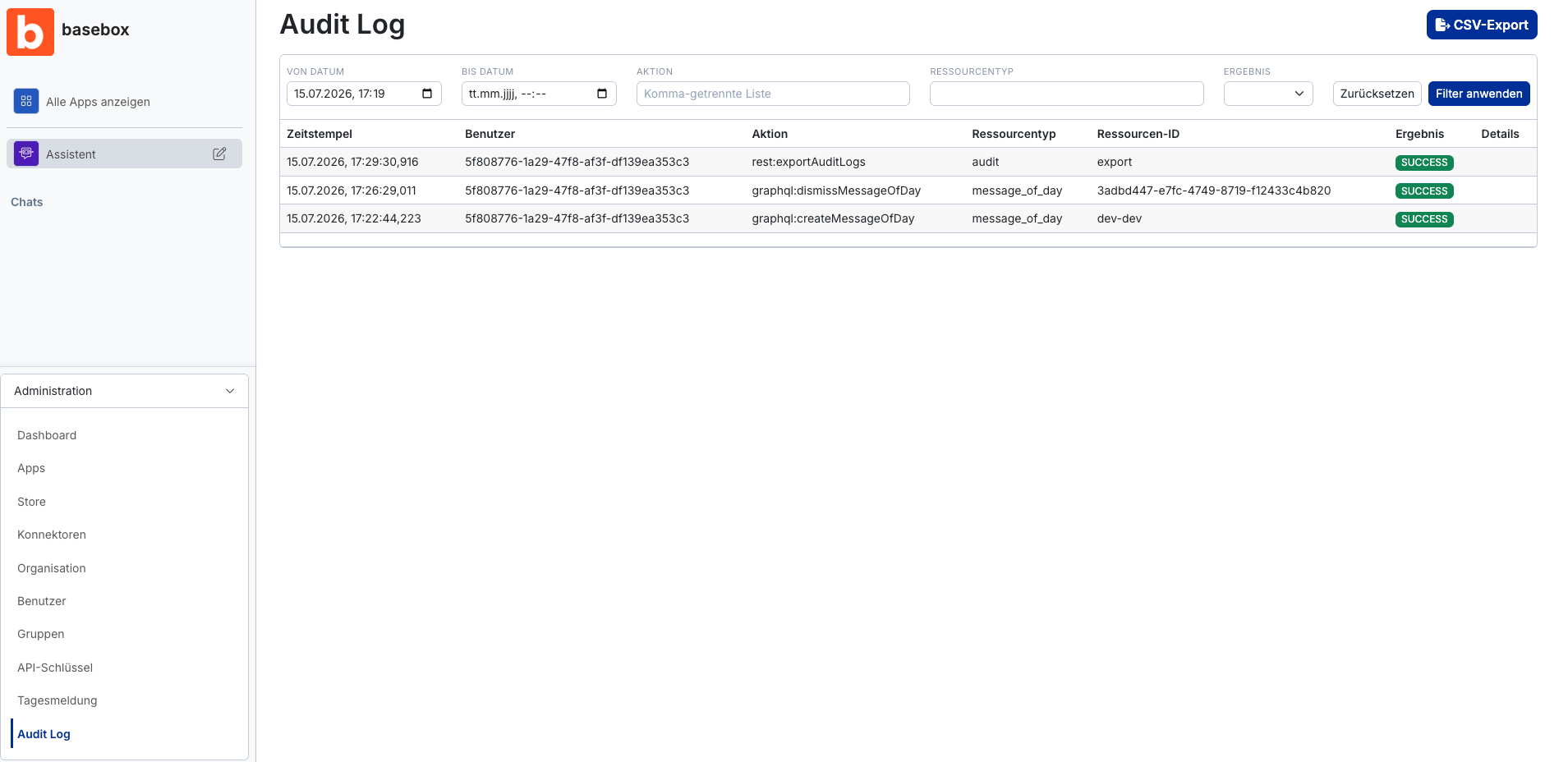
Each entry in the table has the following columns:
| Column | Meaning |
|---|---|
| Timestamp | Date and time of the action, precise to the millisecond |
| User | Identifier of the user who triggered the action |
| Action | The action performed (see "Understanding actions" below) |
| Resource type | Type of the affected object, e.g. user, group, message_of_day, app, audit |
| Resource ID | Identifier of the specific affected object |
| Result | SUCCESS or FAILURE |
| Details | Additional technical information about the action, if available |
Understanding actions
Action names follow a fixed pattern of source and operation:
user.login– A user logged ingraphql:createGroup/graphql:deleteGroup– Group created or deletedgraphql:addUserToGroup/graphql:removeUserFromGroup– User added to or removed from a groupgraphql:editUser– User editedgraphql:createMessageOfDay/updateMessageOfDay/dismissMessageOfDay– Daily announcement created, changed, or dismissedrest:exportAuditLogs– Audit log exported as CSV
This lets you see at a glance what kind of process was logged.
Step by step
Filtering entries:
- Narrow down the time range using From date and To date.
- Optional: Enter one or more actions under Action as a comma-separated list (most reliably using the exact action names from the "Action" column, e.g.
graphql:deleteGroup). - Optional: Restrict to an object type using Resource type (e.g.
group). - Use Result to filter specifically for SUCCESS or FAILURE.
- Click Apply filter to update the list. Reset discards all filters.

Exporting as CSV:
- Set the desired filters first (the export follows the current view).
- Click CSV export at the top right.
- The file is saved locally on your device and can be further analyzed, e.g. in Excel.
Notes
Note
- The view supports paging, filtering, and CSV export.
- Changes to the filters only take effect after clicking Apply filter.
- The Action field expects the technical action names; you'll get the most accurate results by copying a value from the "Action" column exactly.
- Use Result = FAILURE to find failed operations specifically.
- The retention period and the level of detail are configurable: you can decide whether only questions or also the answers are recorded.
Transparency for recorded conversations
Whenever conversation content is being recorded, all users see a clearly visible notice in the chat.
Frequently asked questions
What is logged? Security-relevant actions such as logins, as well as changes to users, groups, daily announcements, and other resources – each with a timestamp, the triggering user, the result, and the affected resource.
How do I find only failed actions? Set the Result filter to FAILURE and click Apply filter.
Can I process the entries further? Yes, use CSV export to download the currently filtered entries as a CSV file; it is saved locally.
Why doesn't the list change when I enter a filter? Filters only take effect after clicking Apply filter.